
Physical therapists often rely on many types of balance discs and pads to support their patients with balance deficits, proprioceptive loss, and postural instability. Whether working with older adults recovering from falls, athletes retraining their core, or individuals with neurological impairments, having the right balance pad or disc can significantly impact outcomes.
From simple foam pads to high-tech interactive platforms, each product in this list brings something unique to the clinic. Below, we’ll walk through our firsthand experiences with nine of the best balance pads and discs available today.
A balance disc is air-filled and offers dynamic instability for core strength and proprioceptive training, while a balance pad is made of foam and provides more static instability for controlled postural work. I use both regularly, depending on whether my patient needs sensory input or controlled strengthening.
It challenges the user’s ability to maintain equilibrium on an unstable surface. Balance discs are used for core engagement, posture training, and ankle stabilization, and I find them especially helpful in dynamic balance exercises and postural retraining.
Each type of balance pad or disc has a specific clinical value. Understanding these differences helps ensure the right tool is matched to the right patient need, whether it's static balance, dynamic control, or sensorimotor integration.
Made from high-density or closed-cell foam, these pads provide soft, static instability that gently challenges postural control. Ideal for beginners, older adults, or patients recovering from lower limb injuries, they are a foundational tool in fall prevention programs and proprioceptive retraining.
These discs contain adjustable air chambers and provide dynamic instability, requiring constant micro-corrections. They're excellent for core strengthening, dynamic balance, and seated posture work. They're frequently used with athletes and post-concussion patients to re-engage deep stabilizing muscles.
These are high-tech solutions that incorporate sensors, feedback screens, or gamified interfaces to track performance. They're particularly valuable in cognitive-motor rehab, stroke recovery, and dual-task balance training.
These products combine flat and dome surfaces to engage multiple planes of motion. These tools are ideal for advanced rehabilitation, sports performance, and vestibular therapy requiring reactive control.
Designed to activate the deep core and pelvic stabilizers, these unique tools target foundational balance support and spinal alignment. They're used especially with postpartum clients or those recovering from low back pain.
 | Airex Balance Pads for Vestibular Training and Exercise View Product |
The Airex Balance Pad has long been a staple in vestibular and orthopedic rehab. Its closed-cell foam construction offers the ideal level of instability for static and dynamic training. It’s often used with patients relearning basic weight shifts or single-leg stance, especially after joint replacements or stroke.
Best for: Beginners, elderly patients, and foundational balance exercises.
Why we love it: It's lightweight, hygienic, and incredibly versatile. The foam gently challenges balance without overwhelming the vestibular system.
For patients who need motivation or cognitive engagement during therapy, the QPads system is a game-changer. It uses illuminated targets and sensor-based feedback to gamify movement tasks. It’s used frequently with pediatric patients or adults recovering from brain injury.
Best for: Neurological rehab, attention training, and dynamic stability.
Why we love it: It tracks foot placement in real time and challenges both cognition and balance simultaneously, which is key for functional reintegration.
 | Norco Balance Bubble for Stability and Balance Training View Product |
This air-filled, dome-shaped disc provides dynamic feedback for seated and standing tasks. Use it under the feet for squats or as a seat cushion for core activation. It’s particularly helpful for sensory seekers or patients with decreased proprioception.
Best for: Core activation, dynamic standing balance, sensory integration.
Why we love it: The variability in air pressure allows me to tailor difficulty across patient populations.
 | Physical Therapy Balance Board with Wearable Sensors and App Connectivity - BoBo Pro 2.0 View Product |
The BoBo Pro pairs a balance board with an app to provide real-time feedback, posture tracking, and gamified challenges. Use this with higher-functioning patients, including athletes or post-concussion clients, to fine-tune dynamic control.
Best for: Athletic rehab, vestibular retraining, and dual-task training.
Why we love it: You can track progress session-to-session and adjust programming based on objective data.
 | Togu Challenge Disc for Improved Balance and Coordination View Product |
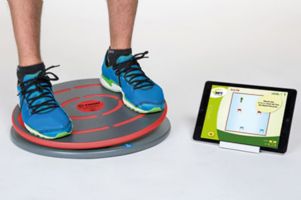
This balance disc stands out because of its adjustable air valve, allowing fine control over instability levels. It’s excellent for bridging the gap between basic foam pads and wobble boards.
Best for: Intermediate-level patients needing progression from foam to dynamic instability.
Why we love it: It’s compact but delivers major therapeutic value. Great for one-legged training, tandem stance, or perturbation practice.
 | OPTP Pro Balance Pad - Foam Stability Trainer View Product |
The OPTP pad offers more firmness compared to the Airex, which is helpful when working with patients needing less sink but still some challenge. You can use this with individuals recovering from ankle sprains or postural imbalance.
Best for: Orthopedic rehab, seniors with mild balance issues.
Why we love it: It doesn’t compress too quickly, so it remains challenging even after repeated use.
 | Fitterfirst Professional Rocker Board View Product |
The Fitterfirst Professional Rocker Board is a durable wooden balance board that offers controlled, single-plane tilting for progressive balance and lower-limb rehabilitation. Its adjustable tilt settings of 10 degrees, 12 degrees, and 15 degrees provide graded levels of incline for progressive balance and proprioceptive training.
Best for: Enhancing neuromuscular control, joint stability, and lower-limb strength.
Why we love it: The board’s single-direction movement and stable design allow patients to build confidence while being challenged to improve leg strength and balance.
.jpg&newwidth=365&maxheight=200 "Bosu Balance Trainer Ball") | Bosu Balance Trainer Ball View Product |
The BOSU Balance Trainer remains a clinic favorite for full-body balance and strength training. It’s used for everything from core activation to reactive balance training.
Best for: Athletic populations, vestibular rehab, dynamic movement training.
Why we love it: It’s incredibly versatile and safe to use dome-side up or down, making it a must-have in every balance program.
 | Balance Disc for Core Stability and Strength Training - Pelvic Rocker Core Trainer by OPTP View Product |
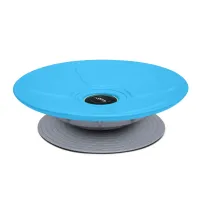
While not a traditional balance disc, the Pelvic Rocker trains the deep core and pelvic floor, both critical for balance and trunk stability. We find this especially helpful for patients with low back pain or postpartum instability.
Best for: Core stability, low back rehab, pelvic realignment.
Why we love it: It builds foundational strength that translates directly to improved balance and posture.
Yes, they are ideal for older adults at risk of falls. Their soft surface challenges the proprioceptive system gently and safely, helping reduce fall risk and improve gait.
You can sit on it for short periods to promote active sitting and core activation, but extended use without rest can lead to fatigue. We recommend alternating with a stable seat or taking breaks every 30–60 minutes.
Absolutely. They are widely used in ankle sprain rehabilitation to retrain proprioceptive feedback and joint stability. Clinical evidence supports the role of unstable surfaces in recovery.
Yes, they are highly effective in activating deep stabilizers such as the transverse abdominis and pelvic floor. We use them during sitting or standing exercises for core reconditioning, spinal rehab, and return-to-sport training.
Both have distinct benefits. Use a balance pad for early rehab, static control, or older populations. Opt for a balance disc for more dynamic challenges and core-focused interventions. Most therapists frequently alternate between the two depending on the patient’s stage and goals.
Whether you’re working with older adults at risk of falls, athletes in post-injury rehabilitation, or patients rebuilding neuromuscular control after a neurological event, the right balance pad or balance disc can enhance outcomes significantly. From the foam dependability of the Airex Pad to the tech-forward precision of the K-FORCE Balance Plates, each tool we’ve reviewed supports specific therapy goals. When chosen thoughtfully, balance tools empower patients to move with greater confidence, control, and safety, one step, one stance, one shift at a time.

Megan has been a part of Rehabmart since its inception nearly 20 years ago. For the past several years she has been enjoying her role as HR Director while maintaining her Physical Therapy license. When she isn't working on her next in-service or working to find a new team member, she enjoys her five children, helping those who have PT type ailments, baking, practicing yoga, and working out.







.jpg&maxheight=250&width=365&product_name=Bosu Balance Trainer Ball "Bosu Balance Trainer Ball")


