
Shoulder supports and braces help people recovering from surgery, managing chronic conditions, or preventing further injury during daily activities. Shoulder pain shouldn't stop you from living your life. A shoulder support provides targeted compression, stability, and pain relief for injured or weak shoulders, helping you heal faster and move more comfortably.
Understanding how to choose the right shoulder support depends on your specific injury, activity level, and recovery goals.
Think of a shoulder support as a gentle assistant that holds your shoulder in the right position while it heals. The support wraps around your shoulder and chest, taking weight off damaged tissues.
Here's what shoulder supports do:
A shoulder support works simply. It distributes the weight of your arm across your chest and opposite shoulder, taking strain off the injured area. Whether you're recovering from rotator cuff repair, managing a frozen shoulder, or healing from a dislocation, the goal remains the same: protecting your shoulder while it heals naturally.
Shoulder braces are typically used to support healing, reduce pain, and protect the joint during recovery. Different shoulder conditions benefit from different types of support.
Rotator cuff tears can cause pain and limit movement, especially after surgery. Research shows that when the shoulder is supported in a slightly rotated position, many people experience less pain and improved movement during recovery. Wearing the right brace can play an important role in healing.
A frozen shoulder causes stiffness, pain, and reduced range of motion. A supportive shoulder brace can help manage the discomfort while physical therapy works to restore your movement. Gentle compression and warmth from a well-designed brace may ease soreness and make daily movement more comfortable.
After a shoulder dislocation or separation, keeping the joint properly supported is important to prevent re-injury. Locking the shoulder in a safe position allows tissues to heal and may lower the risk of the shoulder slipping out again.
After shoulder surgery, such as arthroscopic or open procedures, braces help protect the repaired area. Proper support limits any unwanted movement and lessens the strain on healing tissue.
Chronic shoulder conditions, like arthritis or bursitis, usually cause ongoing pain and inflammation. Supportive braces that give gentle compression and warmth can help reduce that discomfort and support daily movements.
Different shoulder injuries and conditions need different levels of support. Understanding the main types of shoulder braces can help make it easier to choose the right one.
Basic compression supports are simple, sleeve-style braces that provide gentle pressure and warmth around the shoulder. This type of support helps improve comfort and can reduce mild swelling or soreness.
The Otto Bock Shoulder Support is made from flexible material that gently conforms to the body. It includes elastic straps and an easy front closure, making it simple to put on and adjust. These supports work well for mild inflammation, arthritis discomfort, minor strains, or returning to activity after healing.
 | Otto Bock Shoulder Support View Product |
Sling and swathe combinations keep the arm supported against the body to reduce movement while staying comfortable. It offers more support than a compression sleeve without feeling tight or confining. Slings on their own, however, are used to keep the shoulder and arm still after soft tissue injuries, strains, or instability, so healing can begin.
The ARYSE Adjustable Comfort Shoulder Brace combines a soft sling with a padded wrap around the torso. This design helps keep the shoulder supported while remaining lightweight and comfortable.
 | ARYSE Adjustable Comfort Shoulder Brace View Product |
Shoulder stabilizers offer more focused support than standard slings. Their adjustable straps control shoulder movement without fully locking the arm in place. This makes them useful for people who need stability while staying active.
The Sully Shoulder Stabilizer uses adjustable, multi-directional straps, making it a practical option for people with shoulder instability who want to remain active. It limits risky shoulder positions while still allowing normal arm movement for daily tasks or sports.
 | Sully Shoulder Stabilizer View Product |
Abduction braces hold the arm slightly away from the body to protect healing tissue during recovery. This position is often used after injury or surgery to keep the shoulder aligned and limit movements that could interfere with the healing process.
The Shoulder Abduction Support System allows the arm to be positioned at different angles, ranging from 0 to 90 degrees. The adjustable design lets the arm angle be changed as healing continues and new movement limits are set.
 | Shoulder Abduction Support System, Universal Size by Advanced Ortho View Product |
Dynamic harnesses are used during rehabilitation when the shoulder needs to move in a controlled way instead of being fully held still. They limit certain shoulder motions while allowing others during exercise or daily tasks. These harnesses are used during therapy when the shoulder needs to have mobility while still being guided and controlled.
The Therafit Dynamic Adjustable Harness uses a Y-shaped frame to guide shoulder movement while keeping the arms free to move. Adjustable straps and quick-release buckles make it easier to put on, adjust, and remove as needed.
 | Therafit Dynamic Adjustable Cross Body Y-Harness by Performance Health View Product |
Combination ice and compression braces apply cold therapy and pressure to the same area at the same time. They are commonly used after injury or surgery to help manage swelling and discomfort while the joint is at rest. These braces hold an ice pack in place while adjustable straps apply compression around the joint. This setup allows cold therapy to stay in contact with the area without the need to hold or reposition the pack.
The Ice and Compression Therapy Shoulder Brace from G-Force uses wraparound straps to secure removable cold packs directly over the shoulder. The brace can be adjusted for fit and worn without holding the pack in place, which makes it easier to manage icing sessions on a set schedule.
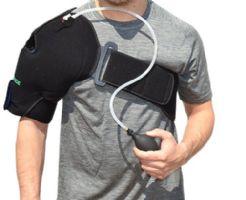 | Ice and Compression Therapy Shoulder Brace - G-Force View Product |
Quality materials make a huge difference in comfort and effectiveness:
Look for supports with multiple adjustment points:
Left vs. Right Shoulder: Most quality supports work on either shoulder. Universal designs save money and provide flexibility. Check product specifications to confirm.
Ease of Application: Can you put the support on yourself? This matters for independence. Look for: clear instructions with diagrams, front-closing designs, finger loops that help with adjustments, lightweight construction that's easy to handle
Washability: Shoulder supports need regular cleaning. Choose supports that have removable pads for thorough cleaning and can be machine-washed on a gentle cycle. It’s also important to look for supports that air dry quickly and maintain their shape and elasticity after washing.
Not everyone needs shoulder support, but for many people, it makes recovery easier and less painful. A good shoulder brace helps protect injured tissues, reduces strain during daily activities, and gives your shoulder time to heal properly. If your pain keeps coming back or movements feel unstable, a support can make a noticeable difference.
The best shoulder support depends on what’s going on with your shoulder. Mild pain or arthritis usually needs light compression, while surgery or dislocations often require stronger support or immobilization. Think about your injury, how active you are, and whether you need support all day or just during certain activities. When in doubt, your doctor or physiotherapist can point you in the right direction.
Some shoulder supports are made for all-day wear, but not all are comfortable or safe to sleep in. If your provider recommends wearing one overnight, especially after surgery, choose a brace designed for sleeping. If not, it’s usually best to remove it at night to give your skin a break and stay comfortable.
It shouldn’t, if you choose the right level of support. Light and moderate braces allow movement while still protecting your shoulder, which is great for daily tasks and rehab exercises. Stronger braces are meant to limit motion on purpose, especially after surgery or dislocation. The goal is protection without unnecessary restriction.
This varies from person to person. Some people only need support for a few weeks, while others use it longer for chronic conditions or during specific activities. As your shoulder gets stronger and pain improves, you may be able to reduce or stop wearing it. Pay attention to how your body feels, and follow your healthcare provider’s guidance for the best results.
Shoulder supports can play a practical role during recovery by limiting unsafe movement and keeping the joint in a stable position during daily activities. Different injuries and recovery stages require different types of support, ranging from braces that hold the arm still to options that allow guided movement. Choosing a shoulder support that fits correctly and matches daily use needs can help make recovery routines easier to manage while the shoulder continues to heal.

Megan Smith, PT, Executive Director of HR
Megan has been a part of Rehabmart since its inception nearly 20 years ago. For the past several years she has been enjoying her role as HR Director while maintaining her Physical Therapy license. When she isn't working on her next in-service or working to find a new team member, she enjoys her five children, helping those who have PT type ailments, baking, practicing yoga, and working out.







~44.jpg&maxheight=250&width=365&product_name=ARYSE Adjustable Elevation Shoulder Brace "ARYSE Adjustable Elevation Shoulder Brace")


~1.jpg&maxheight=250&width=365&product_name=G-Force Sleeper Shoulder Brace "G-Force Sleeper Shoulder Brace")


