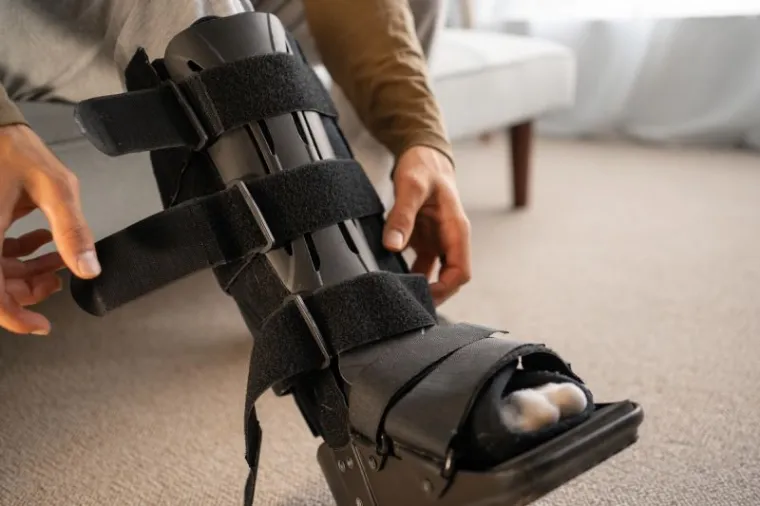
When a person spends extended time in bed or seated, protecting the feet and ankles becomes especially important. In these situations, Multi Podus boots provide structured support that helps maintain a safer foot position while reducing pressure on the heel. They are designed to cushion, stabilize, and promote proper alignment during periods of rest.
Unlike regular walking boots, Multi Podus boots are usually not for walking. Some models may let a person stand briefly with help for moving or transferring, but their main job is to keep the foot aligned and reduce pressure during long periods of rest. That’s why Multi Podus boots are used in some situations, and other boots are used in different situations.
During extended periods of rest, Multi Podus boots help protect the foot and ankle in several important ways:
The Multi Podus Orthoses with Transfer Attachment adds a built-in transfer feature, letting a person stand briefly with help while still keeping the heel off the bed and the ankle properly aligned. The Dorsiflexion Multi Podus System supports the foot in a neutral or slightly raised position to help prevent foot drop and reduce pressure points during long periods of rest. Both boots have adjustable straps and a floating heel for comfort and support.
 | Multi Podus Ankle Foot Orthosis View Product |
 | Dorsi-Flexion Multi Podus System View Product |
Other types of boots are usually meant to help with walking or protect the foot during activity, not for resting. These boots are often used when someone needs support while standing or walking.
Some boots are built to limit certain movements and control how the foot bears weight while walking. For example, controlled ankle motion (CAM) boots can reduce ankle movement and guide how forces move through the foot.
When support is needed during standing or walking, other boot styles are designed to:
Comparing these boots with Multi Podus boots shows where each type is useful. Walking boots or ankle-foot orthoses (AFOs) are best when support is needed during movement, while Multi Podus boots are chosen for resting, alignment, and pressure relief.
Among foot and ankle supports, Multi Podus boots play a distinct role. They are especially helpful when proper positioning and pressure relief are the primary goals. Comparing them with other types of boots highlights how different designs serve different stages of care. Recognizing these differences can make it easier to select the most appropriate option for each situation.

Co-founder/CEO of Rehabmart, Pediatric Occupational Therapist, husband, and father. Passionate about connecting special needs kids with superb nutrition, sensory integration, and complementary health strategies. Excited about Rehabmart's mission to become the premier online educational platform which empowers caregivers by spotlighting innovative devices and interventions to achieve optimal patient response and recovery.





 "Push Natural Gait Ankle Foot Orthosis (AFO)")


 for Foot Drop and Instability "Supra-Lite Ankle Foot Orthosis (AFO) for Foot Drop and Instability")

