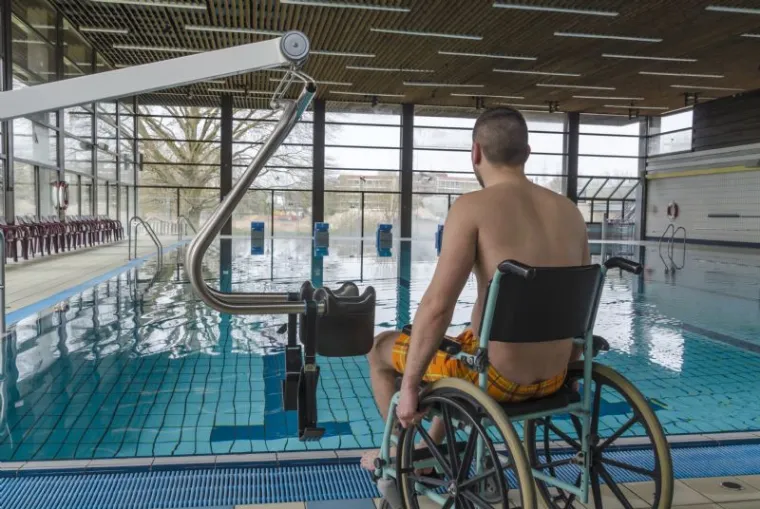
Pool lifts can make or break the rehabilitation experience. These devices aren’t just tools—they are gateways to independence, confidence, and clinical progress. Whether you’re running a commercial aquatic center, managing therapy services at a hospital, or setting up a home pool for someone with limited mobility, this guide will help you choose the right pool lift from our top 8.
A pool lift is a mechanical assistive device designed to safely transfer a person with mobility impairments into and out of a swimming pool or hot tub. These lifts come in manual and powered versions, with options for portable or fixed installation.
According to ADA.gov, commercial and public pools must provide accessible entry, and pool lifts are one of the most reliable methods to meet that requirement.
Some pool lifts support standard users (350–400 lbs), while others, like platform or bariatric lifts, support 500–600 lbs. Higher capacity lifts often feature stronger frames and base anchors.
Powered lifts are ideal for independent users or busy facilities. Manual lifts may suffice for home use with caregiver assistance.
360° powered or manual rotation offers easier positioning and transfers. These lifts are ideal for clients who need lateral transfers from wheelchairs.
Portable models are perfect for facilities with multiple pools or changing needs. Fixed lifts provide higher stability and durability for permanent installations
Seated lifts using chairs are more common and are ideal for independent or minimal-assist users. Platform lifts accommodate aquatic wheelchairs directly, and sling lifts offer more full-body support.
Will the user be independent or need caregiver assistance? Are they bariatric, wheelchair-bound, or using a gait trainer?
In-ground vs. above-ground, spa vs. therapy pool—each requires different mounting and clearance capabilities.
Heavy-use environments like hospitals or universities need a robust, powered lift with higher weight capacities.
Portable pool lifts offer flexibility but may be heavier and more expensive.
If you’re operating a public facility, ADA compliance is mandatory.
For a more in-depth look at these questions and more, check out our article on How To Choose a Handicap Pool Lift!
 | Traveler II XRC500 500 lb. ADA Bariatric Pool Lift View Product |
This is our go-to for facilities working with bariatric clients or those recovering from spinal surgeries. With a 500 lb capacity and 360° powered rotation, it’s ideal for skilled nursing or inpatient rehab pools.
Best For: Bariatric therapy, hospitals, skilled nursing
 | Aqua Creek ADA Compliant Spa Lifts - Neptune View Product |
Perfect for raised spas or hot tubs. This lift gets clients over 51-inch walls with ease and makes hydrotherapy in elevated settings possible.
Best For: Spa and hot tub therapy, boutique centers
We’ve installed this in several home pools. It’s budget-friendly and gets the job done with manual operation, but it definitely requires caregiver help.
Best For: Homeowners or caregivers on a budget
 | Power EZ 2 Pool Lift with 360-Degree Rotation from Aqua Creek View Product |
For clients who need powered lifting but don’t need a fully automatic system, this is a solid hybrid. We’ve even used it for adaptive boating access.
Best For: Home pools, docks, and independent use
 | Glacier Platform ADA-Compliant Swimming Pool Lift with 600 lbs. Lifting Capacity and 48 in. Vertical Range View Product |
The gold standard for aquatic wheelchair access. This lift is essential in pediatric and VA aquatic therapy where roll-on entry is needed.
Best For: Wheelchair users, gait trainers, VA facilities
 | Portable Pool Lift Chair with Wheels and 350 lbs. Capacity- Portable Pro Pool 2 from Aqua Creek View Product |
This one’s a lifesaver in community rehab centers. You can move it between pools and store it easily! It’s our top choice for flexibility.
Best For: Hotels, gyms, rehab clinics
.jpg&newwidth=365&maxheight=200 "Global Commercial Series Pool Lift") | Global Commercial Series Pool Lift View Product |
We recommend this to any hospital or university pool that needs reliable, repeated use. It’s tough, ADA-compliant, and has smart safety features.
Best For: High-volume commercial and therapy pools
 | Aqua Creek Extra-Large Pool Lift, 360-Degree Rotation, 500-lb. Weight Capacity, Stainless-Steel Construction, Revolution XL View Product |
This is the Cadillac of pool lifts. It’s ultra-versatile, heavy-duty, and compatible with many therapy configurations. Best used in outpatient rehab programs.
Best For: Clinics needing multifunctional access
A pool lift helps individuals with mobility impairments get in and out of a swimming pool safely. It's commonly used in hospitals, rehabilitation clinics, and accessible public pools.
People with disabilities, elderly individuals, bariatric patients, or those undergoing rehabilitation after surgery often need a pool lift for aquatic therapy or recreation.
Many pool lifts are ADA-compliant, especially those used in commercial or public settings. ADA compliance ensures accessibility standards are met under federal law.
Weight capacity varies by model, typically ranging from 350 to 600 lbs. Bariatric lifts and platform lifts offer higher support.
Yes, specialized lifts like the Aqua Creek Spa Lift Ultra are designed to clear spa walls and offer safe access to hot tubs and elevated pools.
We’ve seen how life-changing a quality pool lift can be. Whether it’s helping a stroke survivor back into the water or giving a bariatric client the ability to move with dignity, the right lift supports healing, autonomy, and inclusion.
Always choose your lift based on:
When in doubt, lean toward safety and comfort—you can’t over-invest in dignity.

Megan has been a part of Rehabmart since its inception nearly 20 years ago. For the past several years she has been enjoying her role as HR Director while maintaining her Physical Therapy license. When she isn't working on her next in-service or working to find a new team member, she enjoys her five children, helping those who have PT type ailments, baking, practicing yoga, and working out.
 Portable Pool Lift Chair with Wheels and 350 lbs. Capacity- Portable Pro Pool 2 from Aqua Creek