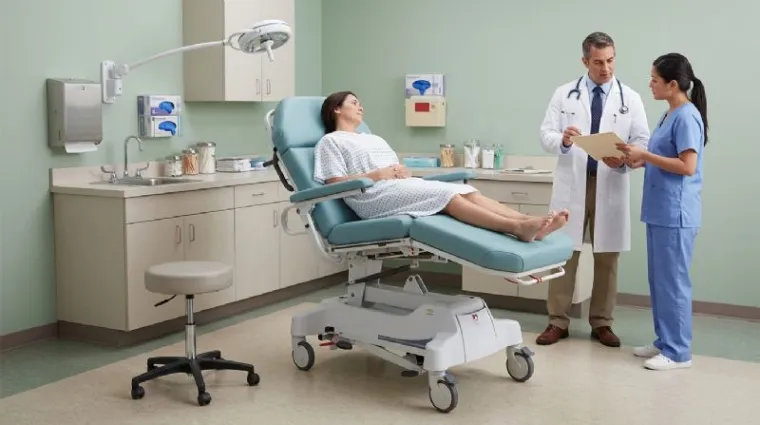
A stretcher chair is a specialized mobility and positioning device that supports patients who require assistance transitioning between seated and reclined positions. Combining elements of a transport chair and a medical stretcher, these systems are intended for assisted movement rather than self-propulsion. They are commonly used in healthcare environments to help facilitate safer, more efficient transport while also supporting positioning needs during different stages of care.
Unlike standard transport equipment, many stretcher chairs function as a convertible transfer chair, allowing users to remain in a single device as they move between upright and reclined positions. This may help reduce the need for repeated transfers between beds, stretchers, and chairs, supporting more consistent workflows and minimizing disruptions during care routines.
Stretcher chairs are used across hospitals, outpatient clinics, rehabilitation centers, and long-term care environments. However, not all models are designed for the same purpose. Some prioritize positioning flexibility, while others focus on transfer assistance or treatment accessibility. Understanding these differences is key to selecting the right solution. This guide explores several stretcher chair options and compares how each one supports real-world clinical and mobility needs.
While all of the following options fall under the category of a stretcher chair, they are designed with different priorities in mind. Some focus on consistent positioning across care stages, while others are built to support more specific needs, such as treatment accessibility or assisted transfers. Understanding these distinctions can help ensure the selected solution aligns with the realities of your care environment.
The Wy’East TC 300 Treatment Chair is supports positioning and active treatment access within a single device. As a stretcher chair, it allows for assisted transport while also enabling clinicians to interact with the individual during care routines.
 | Convertible Exam and Stretcher Chair | Treatment Chair for Safe Patient Handling and Transport with 400 lb Capacity View Product |
Unlike more general-use models, this chair is intended to remain in use during certain procedures or evaluations. This can help reduce the need to transfer individuals to another surface for treatment, supporting a more continuous care experience.
The TC 300 Treatment Chair stands out as a treatment-focused solution, making it especially relevant for outpatient settings or environments where accessibility during care is a priority.
The Human Care H-250 is a convertible transfer chair designed to support assisted transport and repositioning within a single system. It allows patients to transition between seated and reclined positions without requiring separate equipment, helping reduce the need for repeated transfers during routine care.
 | Human Care H-250 Convertible Patient Transfer Chair View Product |
As a gurney chair, the H-250 emphasizes controlled, caregiver-assisted positioning. Its design supports stability throughout movement and repositioning, making it a practical option for environments where consistency and ease of use are important.
Compared to more specialized systems, the H-250 Convertible Patient Transfer Chair serves as a foundational solution. It’s well-suited for general clinical workflows that require a balance of mobility and positioning without added complexity.
The Human Care I-400 builds on the functionality of the H-250, offering a convertible transfer chair designed for environments that require greater adaptability. It supports assisted repositioning while allowing the individual to remain in the same device throughout different stages of care.
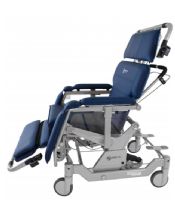 | Human Care Convertible Patient Transfer Chair View Product |
This gurney chair is intended for use cases where positioning needs may change more frequently. It allows caregivers to adjust positioning in a controlled manner, helping support continuity without introducing additional equipment into the workflow.
Within this group, the I-400 represents a more flexible, higher-demand positioning solution while still maintaining a general-purpose design approach.
The Wy’East TotaLift Transfer Chair is designed with a primary focus on assisted transfers rather than extended positioning. While it fits within the broader category of a convertible transfer chair, its core function is to support movement between surfaces such as beds, chairs, or treatment tables.
 | Patient Lift Transfer Chair for No Lift Bed to Stretcher Movement | TotaLift Lateral, Transport, and Treatment Chair with 400 lb Capacity View Product |
All movement is caregiver-assisted, helping support controlled transitions and reducing the complexity often associated with manual transfers. This makes it particularly useful in environments where individuals need to be moved frequently throughout the day.
Compared to traditional gurney chair options, the TotaLift is a transfer-focused solution, prioritizing movement efficiency over reclined positioning.
Although each of these products falls within the stretcher chair category, their differences are most noticeable when viewed through the lens of real-world use.
These models are best suited for environments where maintaining consistent positioning across transport and care stages is a priority.
This model supports positioning and direct interaction during care, making it well-suited for clinical or outpatient use.
This model is designed for environments where frequent assisted movement between surfaces is the primary need.
Choosing the right stretcher chair depends on how it will be used day to day. Facilities that prioritize continuity may benefit from positioning-focused models, while those managing frequent transfers or active treatment scenarios may find more value in specialized solutions.
Stretcher chairs help bridge the gap between mobility and positioning by supporting assisted movement and reducing the need for repeated transfers. This can be especially valuable in environments where consistency and efficiency are essential.
A stretcher chair provides a practical solution for environments where assisted mobility, positioning, and transfer support are all important considerations. By combining the functions of a transport chair and a stretcher, these systems help reduce unnecessary movement between devices while supporting more consistent care routines.
Each model offers a different approach - from positioning-focused systems to transfer-driven solutions - making it important to select a device that aligns with specific workflow needs. When chosen thoughtfully, a stretcher chair can help reduce barriers to movement, support more efficient care delivery, and contribute to a more stable and supportive experience for individuals.
As healthcare environments continue to evolve, solutions that promote adaptability, consistency, and ease of use remain essential. The right stretcher chair can play a meaningful role in supporting both care providers and the individuals they serve, helping create a more accessible and responsive care environment.

Co-Founder of Rehabmart and an Occupational Therapist since 1993. Mike has spent his professional career working in multiple areas of Occupational Therapy, including pediatrics, geriatrics, hand therapy, ergonomics and inpatient / outpatient rehabilitation. Mike enjoys writing articles that help people solve complex therapeutic problems and make better product choices.